


While the World Watches Soccer, Robots Made History in Incheon
05 Jul 2026
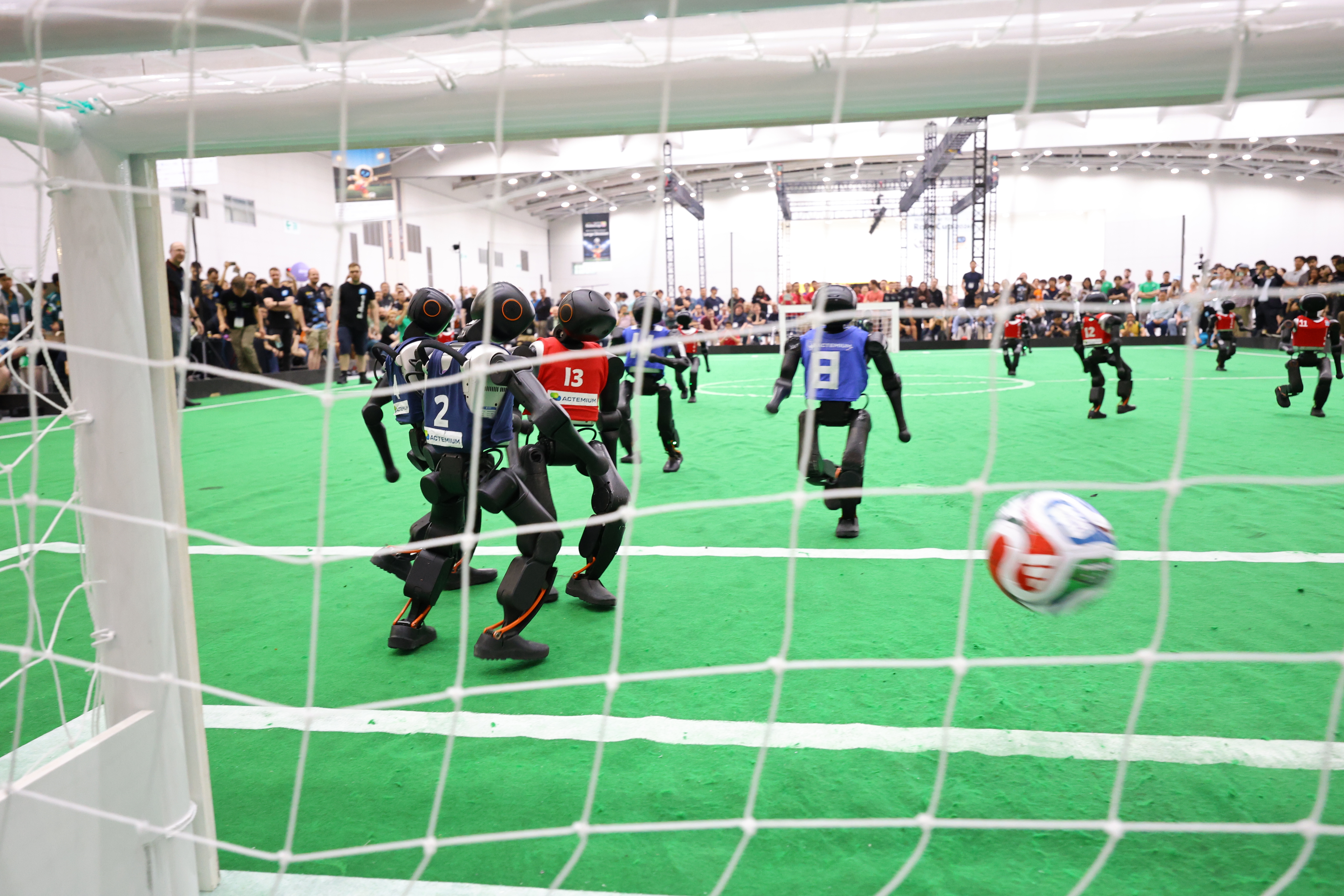
INCHEON, South Korea – 05.07.2026 - Today in Incheon, South Korea, RoboCup 2026 made history. For the first time, two full teams of humanoid robots played an 11-vs-11 soccer match on hardware, bringing one of robotics’ most ambitious long-term visions closer to reality. In a milestone match hosted by the RoboCup Federation, B-Human (Bremen, Germany) defeated HTWK Robots (Leipzig, Germany) by a score of 4:0, marking a breakthrough moment for humanoid robotics, embodied AI, and autonomous systems. Never before have two full-sized humanoid robot teams played a soccer game against each other.
At a time when the world’s attention is focused on soccer, Incheon became the stage for a different kind of match: one not defined by human athletes, but by autonomous humanoid robots walking, perceiving, deciding, coordinating, and competing in the real world.
The achievement represents a major step forward in a journey that began nearly three decades ago. In 1997, a group of scientists set out to usher in a new era in robotics and Artificial Intelligence: instead of robots performing fixed routines and instead of Artificial Intelligence software running on isolated experimental platforms, both would band together to bring intelligence to the robots in a complex and unpredictable environment. And for this, a next-level challenge was needed: something that had never been achieved before and that - then - was far outside of the reach of what traditional thinking thought possible. And so, in the same year in which the then all-dominating chess world champion Garry Kasparov was defeated in competition by the computer program Deep Blue, it was clear that the abstract game of chess is not enough of a challenge for a machine against a human. A new challenge was born that would marry body and brain, AI and Robotics - RoboCup: in the year 2050, to have a team of humanoid robots play soccer against the human world champion - and win!
30 years ago, this was an outlandish goal. But it became the challenge of the 21st century. The very first humanoid competition, still consisting of very limited challenges rather than a full soccer game, took place in 2002, in Fukuoka, Japan. While a lot of progress has been made in the past decades and many milestones were met, playing a full game with real humanoids remained elusive.
However, today, on the 5.7.2026, more than halfway on the path to the 2050 goal, we can announce with great pleasure - RoboCup finally has passed this major milestone: for the very first time in history, two humanoid robot teams play on a real field a full 11 vs. 11 full-sized soccer game at the RoboCup world championship of robotics in Incheon, South Korea: the teams thus making history are HTWK and B-Human, both playing with robots designed by Booster Robotics.
“This match shows how far humanoid robotics has come,” said Ubbo Visser, President of the RoboCup Federation. “We have seen increased teamwork and advanced skills over the years already, but the new humanoid hardware paired with the new level of intelligence provided by AI puts humanoid robot soccer on another level.”The great dream of 2050, which was so far in the clouds in 1997 has made a huge step towards becoming reality. It may be only a small kick for a human, but it is a huge goal for robotics, science, and technology.
Gallery


